2027 Agriculture Cost-Share Program
Virginia Agricultural Best Management Practices Cost-Share (VACS) Program
Since 1984, the Virginia Agricultural Best Management Practices Cost-Share (VACS) Program has grown from a single BMP to over 60 today and has helped thousands of farmers implement practices aimed at keeping the state’s waterways clean.
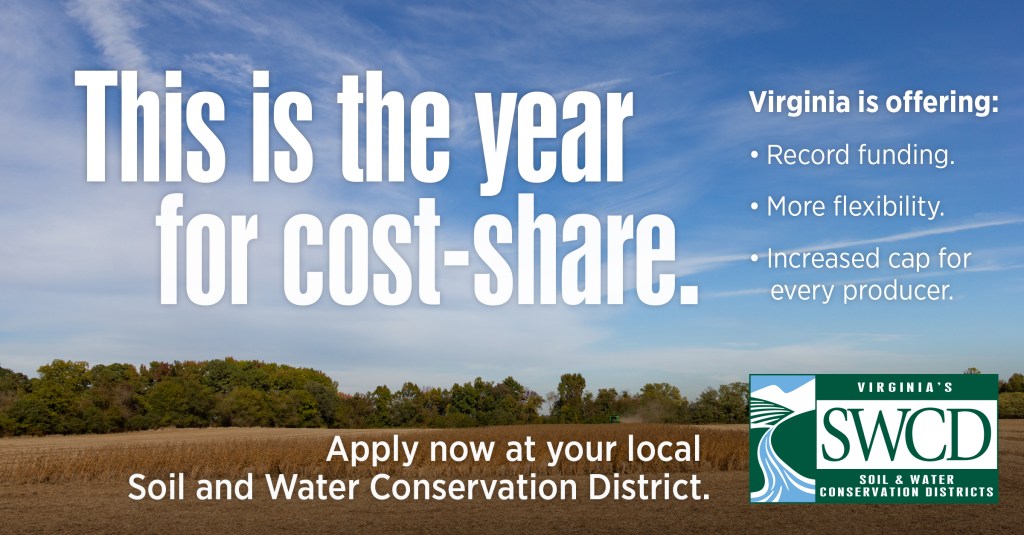
Agricultural BMPs provide a long-term boost to an operation’s bottom line through increased productivity and reduced labor and input costs. A record $207 million in cost-share funds and an additional $31 million in technical assistance is available for fiscal year 2025.
VACS funds a portion of the cost to implement voluntary conservation practices on crop and livestock operations with a cap of $300,000 per farm, per year. BMPs include nutrient management planning, no-till, cover crops, conservation buffers, livestock stream exclusion practices and alternative watering systems for livestock.
Whole Farm Approach
The Whole Farm Approach is a holistic approach to conservation planning that allows farmers to submit just one cost-share application for their choice of nutrient management and cover crop practices, allowing for wider adoption of BMPs while greatly simplifying the application process. For FY 2025, $54 million is reserved for implementing the Whole Farm Approach.
Launched in 2022 as a pilot program to seven districts, the Whole Farm Approach has expanded to 18 districts across Virginia and allows farmers to take into account the entire acreage of their operation when developing conservation plans.
Participants in the Whole Farm Approach are exempt from the $300,000 annual VACS participant cap. It doesn’t prohibit farmers’ participation in other cost-share programs, allowing farmers to maximize savings and environmental benefits.
Conservation Planning
Conservation plans are tools to assist producers in making sound environmental decisions for their operations. In Virginia, farmers can contact their local soil and water conservation districts to partner with certified conservation planners to develop a conservation plan tailored to their specific land and operation. They provide a road map that identifies an operation’s objectives, existing concerns and opportunities, while outlining what the next steps are to reach their goals.
Nutrient Management
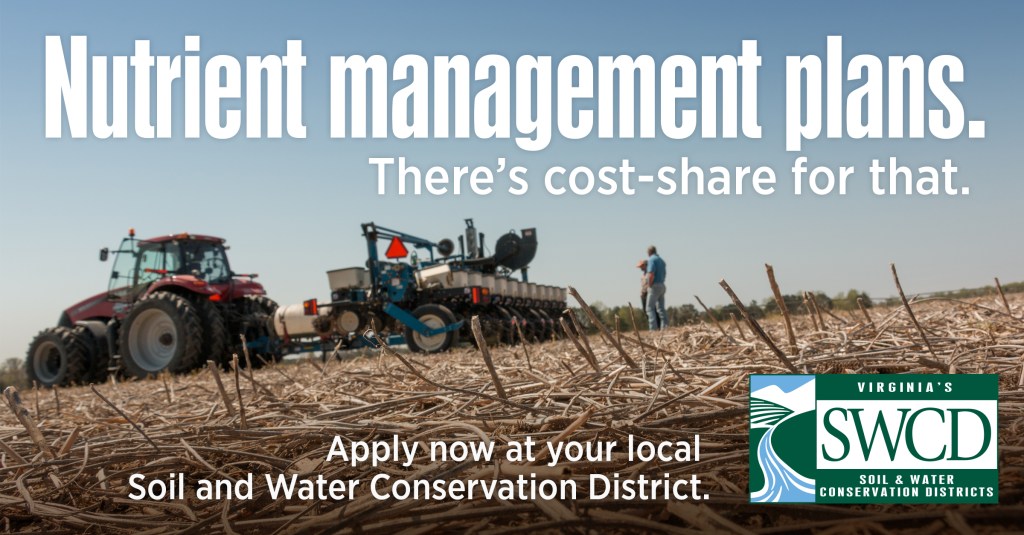
DCR’s Nutrient Management Program addresses nutrient applications to both urban landscapes and agricultural operations in nutrient management plans. Nutrients found in fertilizers, manure, biosolids and other nutrient sources are managed in ways that protect groundwater and surface water from excessive nutrient enrichment.
Nutrient Management Plans improve and protect water quality using best management practices such as timing, rate and placement of fertilizer, manure and biosolids for agricultural and urban purposes.
2026 Agriculture Outreach Program